Is your clinic actually ready for AI?
Almost no clinic fails at AI because of the tool. It fails because the process it was dropped into was never documented, no one owned the change, and nobody checked what the clinic was already paying for.

Most clinic owners we speak to are not short of AI options. They are short of a reason to believe the next one will stick.
The five questions worth answering first
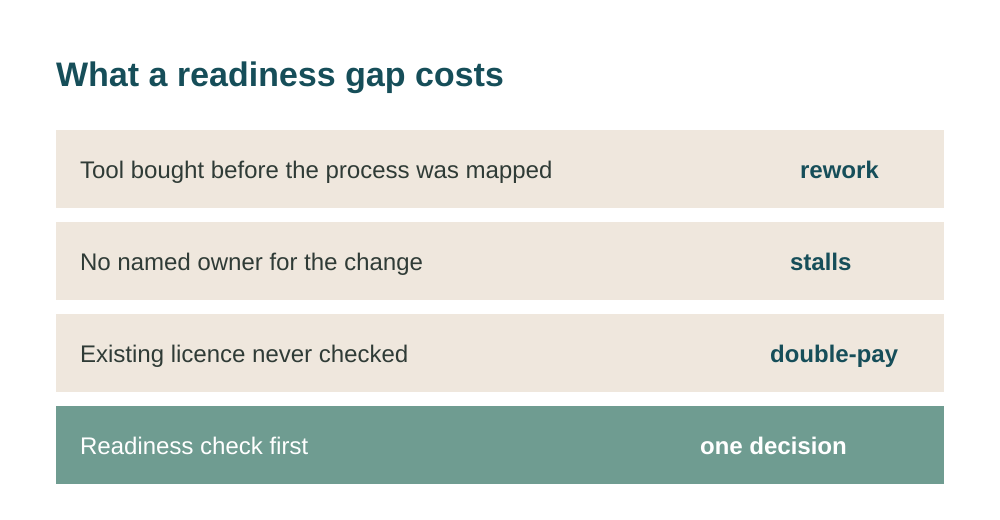
- Are your core processes written down? Not in someone's head - written, with the steps. If not, automation has nothing to attach to.
- Who owns the change? One named person, with the time to do it. "The team" is not an owner.
- What are you already paying for? Most clinics already own software that does part of the job.
- What happens to patient information? Which system it touches, where it is stored, who can see it.
- How will you know it worked? A number, before and after.
What this tells you
If most answers are "we'd have to check", the constraint is not technology. It is readiness - and that is a diagnostic problem, not a software problem.
Next step: the Clinic AI Diagnostic maps the four layers above against what your clinic already owns, and tells you which of the five questions is currently the expensive one.
Common questions
How long does a clinic AI readiness check take?
The self-check takes about five minutes. A full Clinic AI Diagnostic - mapping the existing stack, the data flows and the obligations - is a short, fixed-fee engagement run before anything is recommended.
Do we need to replace our practice management software?
No. Most clinics already own software that does part of the job. The diagnostic starts by mapping what you already pay for, so the recommendation is based on fit rather than a new licence.